


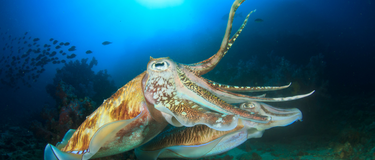
One of the most mystifying creatures of the deep, the cuttlefish has abilities and even senses that are alien to us humans. This versatile animal can change its appearance at will, mimicking floating vegetation or rocks on the seafloor. Yet when danger looms, the animal can jet away at great speeds, shooting out a smoke screen of ink or using its ink to create decoys of itself. How does the cuttlefish accomplish all this? Below, take a look at select parts of this octopus relative and learn more about how this master of deception and disguise functions. — Rima Chaddha
Cuttlefish are much more closely related to garden slugs and snails than they are to fish. They belong to the same group of animals as the octopuses, squid and nautilus and like a snail they are all molluscs. Cuttlefish are unique within this group, in that they have a gas filled bone within their bodies, which allows them to be buoyant. You may have seen cuttlebones before, sticking out from the bars on a budgie’s cage? The bone is within the body part of the animal called the mantle and attached to the mantle is a head with eight arms and two feeding tentacles. The cuttlefish is an ambush predator and a master of disguise. Its skin is covered with special cells called chromatophores, iridophores and leucophores that reflect light in many different colours enabling the cuttlefish to blend into its background almost perfectly. Some say it’s like a chameleon but it is far superior in its ability to change colour and even the texture of its skin! A cuttlefish will steadily, using its camouflage, sneak up on its prey. Their preferred diet is crabs or fish, and when it is close enough it opens apart its eight arms and out shoot two deceptively long feeding tentacles. On the end of each is a pad covered with suckers that grasp hold of the prey and quickly pull it close to the cuttlefish’s mouth that looks like a parrot’s beak. The scientific name for a cuttlefish is Sepia. In years gone by sepia ink, which is derived from cuttlefish, was used by artists for their paintings. For the cuttlefish this ink is a decoy, a means of escape from predators. If a large fish were to attack a cuttlefish it would eject a cloud of dark brown, almost black ink towards its attacker! The predator would get a mouthful of ink that tastes nasty and coats its nostrils. Meanwhile the cuttlefish is hidden from view and propels itself away backwards by using its own jet propulsion system, its siphon. The eggs of cuttlefish are laid in clumps together and are often coated in ink from the mother; this serves as camouflage for the eggs. They hatch at a much further developed stage than an octopus does and immediately start feeding on suitably small shrimp.